Tag: AI agent

  • Why Relying Only on LangChain for Your AI Agent is a Disaster

    Why Relying Only on LangChain for Your AI Agent is a Disaster

    AI Agent, especially building it, is no longer just about writing code that runs locally on your machine, it is about controlling it safely in a production environment. However, many engineering teams are clinging to a dangerous misconception: They believe that simply using LangChain to stitch together LLMs and basic tools is enough to create a flawless autonomous system.

    The harsh reality of production environments proves otherwise. Relying entirely on basic assembly frameworks like LangChain to handle heavy, enterprise-grade workloads is a disaster waiting to happen. It is time to look closely at the limitations of legacy frameworks and understand why a dedicated Observability platform like AgentOps is the only real lifeline.

    1. The Non-Deterministic Nightmare

    Undeniably, LangChain was the “gold standard” for early generative AI development. It does a fantastic job of defining basic execution steps like runs, traces, and threads.

    But the core nature of an AI Agent is non-deterministic. Unlike traditional software with clear, hard-coded logic branches (If/Else), you have absolutely no idea what decision an agentic workflow will make until the user actually inputs a prompt.

    When traditional software fails, you read the code to find the bug. When an AI Agent fails, looking at the LangChain configuration code is entirely useless. The code only contains the prompt and the tool definitions; it does not contain the emergent decision-making logic. The only true source of truth lies in the execution traces. If you deploy using pure LangChain without real-time monitoring tools, you are driving at top speed with your eyes closed. You are leaving your system “flying blind” in production.
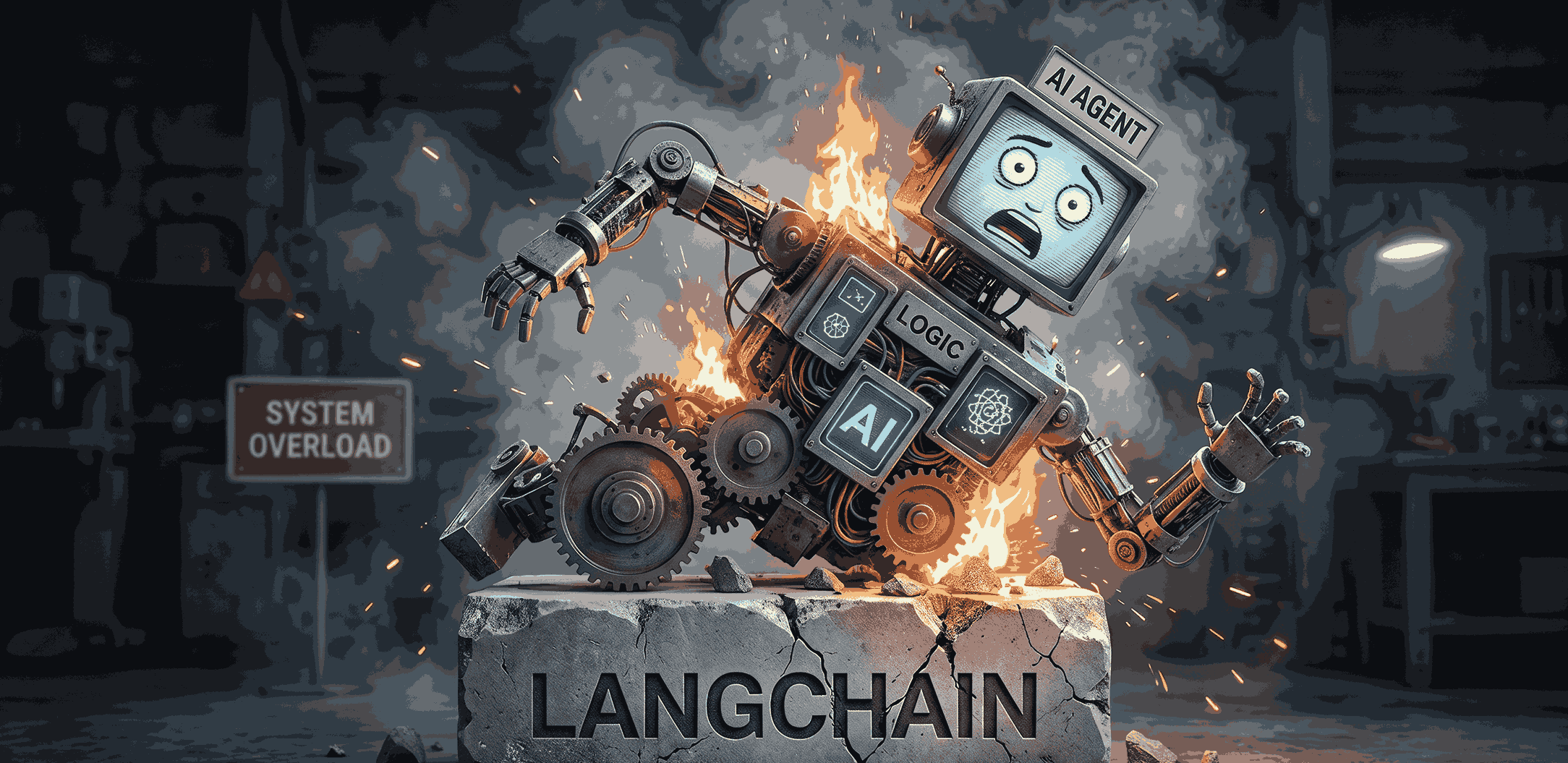
    Furthermore, when an AI Agent built solely on LangChain makes a mistake, it rarely throws a convenient “500 Internal Server Error.” Instead, it fails silently. It might confidently execute a flawless Python function using entirely hallucinated data. If you are forced to dig through massive, nested JSON outputs in a raw console log just to figure out why your agent skipped a crucial reasoning step, you have already lost.

    The only true source of truth lies in the execution traces. If you deploy using pure LangChain without real-time, visual monitoring tools, you are driving at top speed with your eyes closed. You are leaving your system “flying blind” in production.

    AI Agent
    AI Agent built solely on LangChain makes a mistake

    2. A Real-World Disaster in High-Stakes Environments

    To truly grasp the limitations of LangChain, let’s place it in a high-stakes scenario: Healthcare.

    Imagine deploying a multi-agent system to automate medical records and insurance approvals at the Oncology Department of Hue University of Medicine and Pharmacy Hospital.

    • Agent 1 (Clinical Documentation): Tasked with scanning thousands of electronic health records, extracting complex clinical metrics (for instance, evaluating the HBV infection status in patients with primary liver cancer), and compiling a comprehensive medical profile.

    • Agent 2 (Payer Authorization): Takes the profile from Agent 1, navigates the insurance portal, and automatically handles the authorization negotiations.

    On a localized developer demo, this system looks perfect, potentially reducing a grueling 5-day administrative process to just 4 hours. But what happens in the chaotic reality of production?

    Consider the phenomenon of the cascading failure. What if Agent 1 encounters a vaguely worded physician’s note and hallucinates? It might confuse “Patient has a family history of HBV” with “Patient is currently infected with active HBV.” Because LangChain lacks native semantic anomaly detection, Agent 1 confidently outputs a fabricated diagnostic code.

    Agent 2, acting autonomously, takes this false premise as absolute truth. It then files a highly confident, legally binding, but medically false insurance claim. No system crashes. No error logs are generated. It is a silent failure that could lead to denied care for the patient and severe compliance audits for the hospital.

    Alternatively, what if the insurance portal updates its UI slightly? Agent 2 might get confused and trapped in an infinite loop, repeatedly calling a paid API to submit the same document, burning through thousands of dollars in server costs in a matter of minutes. In these life-or-death and high-liability scenarios, LangChain cannot proactively alert you or intervene. By the time human operators notice the failure, the damage is already done.

    3. The Era of AgentOps: Observability, Evaluation, and Optimization

    To prevent AI projects from becoming massive technical debt, top engineers in 2026 have realized a fundamental truth: Writing code for an AI Agent is just step one. Operating, monitoring, and optimizing it is the actual job.

    This is where basic frameworks step aside for the AgentOps platform. A proper Agent Operations framework fills all of LangChain’s blind spots through three critical layers:

    • Layer 1 – Observability: You cannot improve what you cannot see. AgentOps provides a comprehensive dashboard tracking End-to-End Trace Duration and Cost per Request. If an agent gets stuck calling an API repeatedly, the observability system instantly detects the spike in Tool Execution Latency and triggers an automatic failsafe before the budget evaporates.

    • Layer 2 – Evaluation: Observability tells you what the system is doing; Evaluation tells you if it is doing it right. AgentOps continuously monitors the Factual Accuracy Rate and Guardrail Violation Rate. Any sign of an AI Agent leaking sensitive data (PHI leaks) is immediately blocked and isolated for human review, keeping the violation rate strictly at 0%.

    • Layer 3 – Optimization: Armed with data from the first two layers, teams can optimize. Platforms like AgentOps track Prompt Token Efficiency. By identifying wasted tokens, engineering teams can refine their prompts and slash infrastructure costs by up to 39% per request without sacrificing output quality.
    AI Agent
    A proper Agent Operations framework fills all of LangChain’s blind spots through three critical layers

    Conclusion

    In 2026, LangChain remains a fantastic library for snapping the initial building blocks together. However, treating it as a comprehensive solution for deploying an AI Agent to the market is a critical mistake. Enterprises need to stop patching together basic frameworks and start investing seriously in proper observability infrastructure.

    Integrating AgentOps does not just give you x-ray vision into your non-deterministic systems. It is the only guarantee that allows you to confidently run agentic workflows at scale, protecting your users, your data, and your company’s bottom line.
  • AI Agent Costs: How a Single Bug Burned $1,200 in 48 Hours

    AI Agent Costs: How a Single Bug Burned $1,200 in 48 Hours

    The operational dream of Agentic AI is incredibly compelling: deploy autonomous agents, automate complex workflows, reduce headcount, and scale your output effortlessly. It sounds like the ultimate cheat code for enterprise efficiency.

    But while CEOs are calculating projected payroll savings, CTOs and engineering managers are facing a very different reality at the end of the month. The harsh truth is that unoptimized AI agent costs can easily dwarf the savings they were supposed to create. Instead of an efficient digital workforce, teams are waking up to skyrocketing AI agent API costs from OpenAI, Anthropic, or AWS.

    If left unchecked, these autonomous systems are silently burning through your engineering budget at breakneck speed.

    The Anatomy of AI Agent Costs and API Bleed

    To understand why autonomous agents are so expensive and how they rapidly consume your LLM API budget, you have to look at how they operate compared to traditional Large Language Models (LLMs). A standard LLM interaction is linear: you prompt, it answers, and you pay for a few thousand tokens.

    Agentic AI, however, operates on loops, specifically frameworks like ReAct (Reason and Act). To accomplish a single task, an agent doesn’t make one API call, it makes dozens. It thinks, selects a tool, acts, evaluates the result, and loops back. This complex architecture drastically inflates ReAct loop costs and creates three massive financial vulnerabilities that spike your AI agent API costs:

    • Infinite Error Loops: When an agent encounters an unexpected error or a broken tool, its core directive is to figure it out. Instead of failing gracefully, it continuously retries flawed logic, generating thousands of billable tokens per second before any AgentOps tracking or safety net can intervene.

    • Context Window Bloat: Every time an agent loops to think about its next step, it doesn’t just send a new prompt. It sends the entire conversation history, previous reasoning steps, and tool outputs back to the LLM. As the task drags on, the context window expands exponentially, compounding the cost of every single retry.

    • Model Overkill: Defaulting to heavy, expensive models like GPT-4o or Claude 3.5 Sonnet for every minor sub-task (like formatting a date or doing a basic web search) is a massive waste of resources that directly inflates your overall AI agent costs.

    AI agent costs
    Agentic AI creates three massive financial vulnerabilities

    The $1,200 Weekend Bug: A Real-World Disaster

    To put this into perspective, let’s look at a common scenario in production environments that perfectly illustrates how quickly AI agent costs can spiral out of control.

    Imagine you deploy an autonomous agent for competitor analysis to scrape pricing data from various websites. You launch it on a Friday afternoon and head home. At 8:00 PM, the agent encounters a CAPTCHA on a target website.

    Instead of stopping, the ReAct loop kicks in. The agent reasons: “I cannot read the page. Let me try using a different browsing tool.” It fails. It retries. It loops, driving up ReAct loop costs with every iteration.

    Because of context window bloat, by the 50th retry, the agent is passing a 50,000-token history back to GPT-4o every single minute to ask for its next instruction. The agent sits there, silently spinning in the background for 48 hours. By Monday morning, that single, unnoticed bug just burned $1,200 in AI agent API costs, wiping out a massive chunk of your LLM API budget, without delivering a single piece of usable data.

    Stopping the Bleed: The AgentOps Solution

    You cannot optimize what you cannot measure. Throwing an autonomous agent into a production environment without strict observability is a financial hazard that directly threatens your LLM API budget.

    This is where AgentOps tracking transitions from a standard debugging tool to a critical financial safeguard. To stop runaway AI agent costs, engineering teams need micro-cent visibility into their AI workforce. AgentOps provides exactly that:

    • Real-Time Anomaly Detection: If the Competitor Analysis Agent hits that CAPTCHA, AgentOps detects the abnormal spike in token usage and can trigger an auto-kill switch, shutting down the session before it drains the budget and unexpectedly inflates your AI agent API costs.

    • Session-Level Cost Tracking: Stop guessing where the money is going. Know exactly how much your “Customer Support Agent” costs per ticket compared to your internal data-processing agents.

    • Token ROI Analysis: Evaluate whether the sheer volume of tokens an agent consumes during its reasoning loops is actually translating into successful actions and a positive ROI for your Agentic AI ecosystem.

    AI agent costs
    AgentOps transitions from a debugging tool to a critical financial safeguard

    Building Smarter: The Optimization Methodology

    Observability stops the bleeding, but long-term profitability requires structural optimization. You need an agent architecture designed for efficiency from the ground up. This is where specialized engineering teams like Varmeta come in as strategic partners for Agentic AI.

    Rather than just deploying off-the-shelf agents, top-tier implementation partners focus on designing intelligent ecosystems. To prevent budget bloat, firms like Var-meta implement advanced optimization methodologies:

    • Intelligent Model Routing: They build workflows that dynamically route tasks. Simple data extraction goes to low-cost, fast models, while complex reasoning is reserved strictly for premium LLMs. This level of optimization is exactly how developers manage to run heavy setups, like 19 OpenClaw agents, for as little as $6 a month.
    • Prompt & Tool Refinement: By engineering strict constraints and trimming unnecessary context history, they ensure agents hit the mark on the first try, drastically reducing token waste.
    • Deep AgentOps Integration: Architectural experts like Varmeta seamlessly integrate AgentOps into CI/CD pipelines, establishing hard budget limits and custom dashboards so the system runs flawlessly without breaking the bank.

    Conclusion

    Autonomous AI agents are undeniably the future of enterprise operations, but that future shouldn’t come with surprise technical debt or out-of-control AI agent costs. A smart AI strategy requires both the right tools for AgentOps tracking to safeguard your LLM API budget and the right architecture to execute workflows efficiently.

    Let AgentOps be the auditor watching every token, and consider partnering with structural experts like Varmeta for Agentic AI to engineer an autonomous workforce that actually drives profitability, rather than quietly inflating your AI agent API costs.